

Commercial Removals in Chelsea: What Should Move First When Every Minute Matters?
Table of Contents
When every hour of downtime can affect clients, staff and revenue, commercial removals Chelsea businesses need to plan around one question: what should move first? The answer is not always the heaviest furniture. A fast commercial relocation starts with the items and systems that let the business become operational again, while access, security and safety are managed in parallel.
What Should Move First During Commercial Removals in Chelsea?
For commercial removals Chelsea businesses, the first priority should be business-critical equipment and information. This normally means essential IT hardware, key documents, communication equipment and the furniture employees need to resume work immediately. Decorative items, surplus furniture and non-essential stock can follow later if the move is phased.
Before anything leaves the building, create a priority map. Mark each item as “operationally critical”, “important”, or “non-essential”. This prevents bulky desks taking priority over essential equipment.
Prepare the destination first, protect priority equipment, load critical items, then move core workstations. Archives and decorative items can wait.
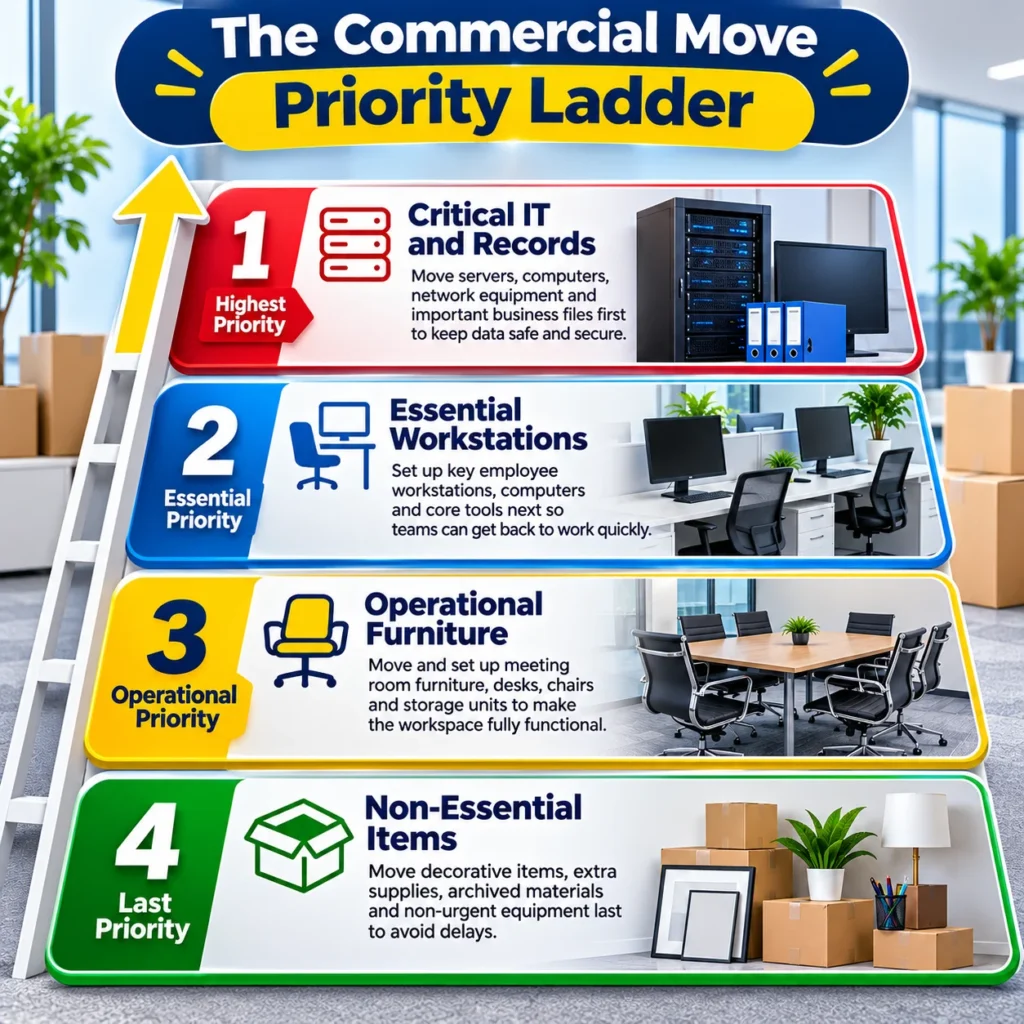
The Practical Moving Order for Commercial Removals Chelsea
Protect data and essential technology
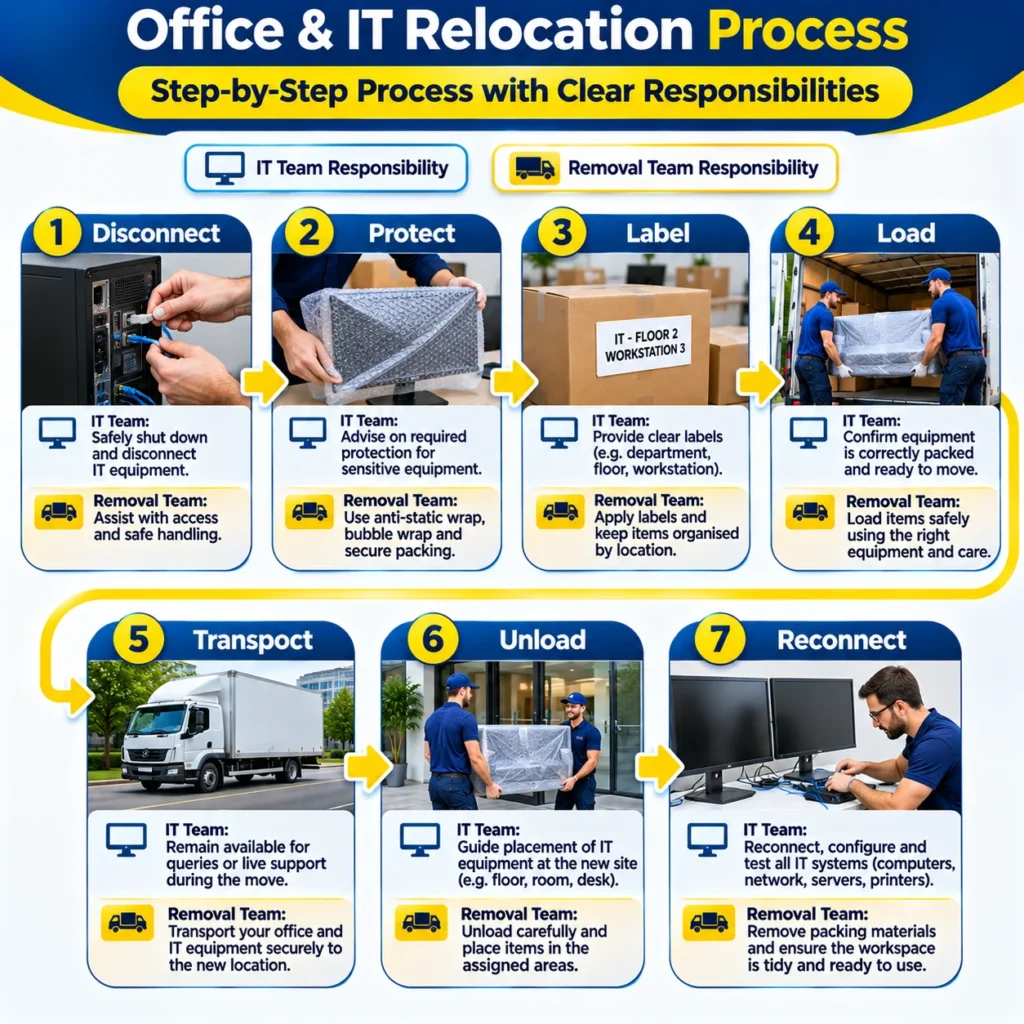
Computers, servers, networking equipment, phones and storage media need early planning, but not necessarily immediate loading. IT teams should confirm backups, shutdown procedures, labelling and reconnection requirements before equipment is moved.
Physical records also need control. The ICO recommends knowing where records are, tracking their movement and keeping them secure during transport because lost or misplaced personal information can create data-protection risks.
Move the equipment that keeps revenue moving
Next come workstations, specialist equipment, tills, printers, tools or stock that employees need to serve customers. If a smaller temporary team can operate, move its equipment first.
Move furniture around the operational plan
Archive material, spare furniture and decorative pieces can wait or enter temporary storage.
Leave low-priority items until last
A label saying “Kitchen” is useful, but experienced movers often need more information. A better system identifies the room and gives a quick indication of important contents or handling requirements.
Clear labelling can make unloading more organised because boxes can be directed towards the correct rooms instead of being placed randomly throughout the property.
What Needs Special Handling?
Commercial removals Chelsea projects can involve glass partitions, artwork, heavy cabinets, confidential files, specialist equipment and fragile electronics, each needing suitable handling.
Safety still matters when the deadline is tight. The Health and Safety Executive says employers should avoid hazardous manual handling where reasonably practicable, assess unavoidable risks and reduce them. Its guidance covers lifting, lowering, pushing, pulling and carrying.
There is no universal “safe weight”. HSE says risk depends on the task, load, environment and individual capacity.
Rushing employees into heavy lifting can create more delay. Use suitable equipment and trained movers, and keep routes clear.
Chelsea Access and Parking Can Change the Schedule
For commercial removals Chelsea projects, the distance between a vehicle and the entrance can significantly affect moving time. Check loading arrangements, building rules, lift access, stairways, reception procedures and property-manager requirements before moving day.
The Royal Borough of Kensington and Chelsea states that office removals do not automatically require a parking-bay suspension, but vehicles must not obstruct the road and loading must be continuous. Suspension and yellow-line dispensation arrangements are available where needed.
RBKC currently states that resident bays generally require 10 full working days’ notice, while pay-by-phone bays generally require two.
Access planning should therefore happen before the van arrives, not after.
How to Control Cost and Downtime
For commercial removals Chelsea businesses, the cheapest move is not necessarily the lowest hourly rate. Excluded waiting, access, crew, packing or protection costs can increase the final bill.
Ask for pricing based on inventory, floors, lifts, access distance, moving window and special items. Clarify what packing, dismantling and reassembly include.
If the business cannot close for a full day, consider a phased move. Move non-critical storage separately and transfer essential departments during a low-activity period.
Changing premises can affect business-rates administration. The UK Government advises businesses to report relevant changes so valuation and billing information remains accurate.
Choosing a Removal Partner for a Fast Commercial Move
A suitable commercial removal company London businesses use should discuss logistics before moving day. Ask about access, fragile equipment, protection, loading, insurance and documentation.
Look for clear pricing, insurance, trained staff and a documented plan. The Trading Standards-approved British Association of Removers code covers customer protection and staff training for participating members.
Sameday Removals Ltd lists commercial removals and office moves among its services, including office furniture, files and business equipment.
During commercial removals Chelsea businesses often need flexible scheduling. Ask whether the mover can work around your timetable. An early start, evening move or phased loading may be more useful than a standard daytime service.
Key Takeaways
For commercial removals in Chelsea, businesses should prioritise operational continuity rather than simply moving the biggest items first. Protect data, move essential technology and revenue-critical equipment in a controlled sequence, and leave non-essential furniture and archives until later.
Chelsea access planning can be as important as transport. Confirm building procedures, loading and parking early, then choose a team that understands safe handling and continuity.
If your Chelsea move has a tight deadline, what needs to be operational first: your IT, customer-facing area, stock, records or staff workstations?
Looking for removal service in London?
0795-145-5002
Frequently Asked Questions
1. What should be moved first during a commercial office relocation?
Business-critical technology, essential documents and equipment required to restart daily operations should receive priority. Non-essential furniture, archives and decorative items can normally be moved later.
2. How long does a commercial removal in Chelsea take?
The duration depends on the volume of goods, number of floors, lift access, distance between vehicle and entrance, packing requirements and destination arrangements. A pre-move survey can provide a more realistic estimate than calculating time from the number of boxes alone.
3. Can a business relocate without closing for the day?
Yes, a phased relocation can allow essential departments to continue operating while other areas are moved. Businesses can also schedule parts of the move during evenings, weekends or quieter trading periods.
4. Do I need a parking suspension for an office move in Chelsea?
Not automatically. RBKC states that office removals can use available parking or certain restricted areas when loading and unloading is continuous and does not cause an obstruction, while suspensions or dispensations may be appropriate in specific circumstances.
5. How much notice is needed for a parking suspension in Kensington and Chelsea?
The current RBKC guidance generally requires 10 full working days for resident parking bays and two full working days for pay-by-phone bays. Short-notice arrangements may be available in certain circumstances and can involve additional charges.
6. How should confidential business records be moved?
Records containing personal or sensitive information should be securely packed, tracked and protected during transportation. The ICO recommends maintaining knowledge of where physical records are and tracking their movement to reduce the risk of loss or inappropriate access.
7. Can employees move heavy office furniture themselves?
Employers have responsibilities under the Manual Handling Operations Regulations 1992 to avoid hazardous manual handling where reasonably practicable and assess unavoidable risks. HSE recommends reducing risks rather than relying on a universal weight limit.
8. What affects the cost of commercial removals?
The main factors can include the quantity and type of goods, crew size, vehicle requirements, access, floors, lifts, packing, dismantling, protection and moving hours. A detailed inventory and site assessment can help reduce unexpected charges.
9. Should IT equipment be moved before office furniture?
IT equipment should be planned early because disconnection, protection, transportation and reconnection can affect business continuity. However, the physical loading order should follow the agreed IT shutdown and destination-readiness plan rather than simply moving technology first.
10. What should I check before hiring a commercial removal company?
Check its insurance arrangements, experience with commercial moves, handling procedures, pricing structure, equipment, staff training and approach to access planning. It is also useful to confirm exactly what is included in the quotation and how unexpected delays or additional requirements are handled.